1. Background & Challenge
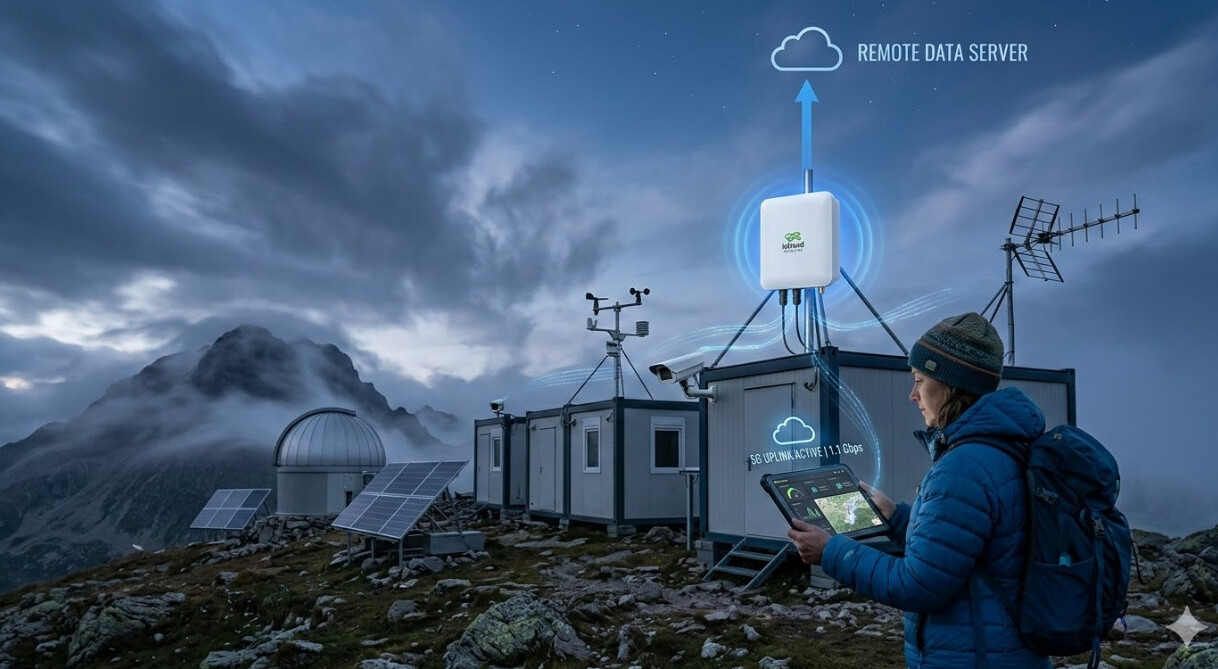
A scientific research team operates a remote station in a mountainous region to monitor local climate patterns and wildlife activity. The project faces several infrastructure challenges:
- Lack of Wired Infrastructure: The remote location makes it impossible or cost-prohibitive to install fiber optic or traditional wired broadband.
- High Data Volume: High-resolution weather cameras and environmental sensors generate massive amounts of data that must be uploaded to a central server in real-time for analysis.
- Extreme Environmental Conditions: The station is exposed to heavy rain, high humidity, and extreme temperature fluctuations.
- Management Difficulties: Technical staff are based in a city hundreds of kilometers away, making on-site troubleshooting difficult and expensive.
2. The Solution: InHand 5G ODU2002
The research station deploys the InHand 5G ODU2002 as the primary high-speed communication gateway, paired with the InCloud Manager SaaS for remote orchestration.
3. Implementation Workflow
- Reliable Outdoor Installation: The ODU2002 is mounted on a pole at the highest point of the station using its flexible installation kit. Its IP67-rated metal housing ensures it remains operational despite heavy precipitation and dust.
- Simplified Powering: Using Power over Ethernet (PoE), the device is powered through a single data cable, eliminating the need for complex outdoor power wiring.
- High-Speed 5G Uplink: The device utilizes 5G technology to provide download speeds of up to 4.76Gbps and upload speeds of 1.25Gbps, easily handling 4K video streams and large sensor datasets.
- "Always-Online" Stability: To prevent data loss during signal fluctuations, the device uses dual SIM switching and 5G/wired backup to maintain a constant connection to the cloud.
- Remote Management: Researchers use the InCloud Manager to monitor cellular signal strength (RSRP,SINR) and perform batch firmware upgrades without traveling to the site.
4. Key Results and Benefits
- Extreme Durability: The device operates reliably within the station's wide temperature range of -30℃ to $70℃.
- Rapid Deployment: With zero-touch deployment capabilities, the hardware was configured in the city and became operational immediately upon being plugged in at the research site.
- Reduced Operational Costs: Remote diagnostic tools and visualized network monitoring reduced the need for manual on-site inspections by approximately 60%.
- Scientific Efficiency: The high-speed 5G uplink allows for real-time data processing, enabling the team to respond to environmental events as they happen rather than waiting for manual data collection.