1. Business Challenges
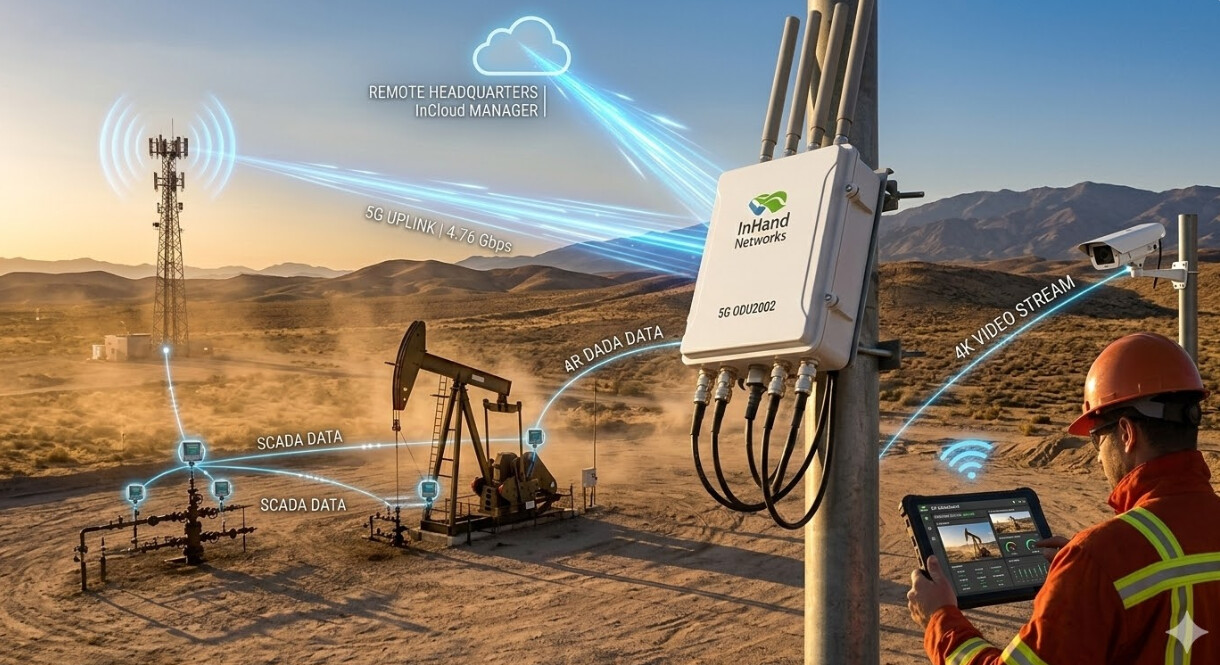
Oil and gas fields are often located in remote, harsh environments such as deserts or mountains where wired communication infrastructure is non-existent. Operations face several critical challenges:
Extreme Environments: Equipment must operate reliably under high/low temperatures, sandstorms, and potentially corrosive salt mist.
High Maintenance Costs: Geographical isolation makes manual on-site inspections and troubleshooting extremely time-consuming and expensive.
High Data Transmission Needs: Real-time SCADA data and high-definition video surveillance are required to ensure production safety and prevent environmental incidents.
2. The Solution: InHand 5G ODU2002
By deploying the InHand 5G ODU2002 as a high-speed communication gateway at remote wellheads and gathering stations, companies can leverage 5G's high bandwidth and low latency, managed centrally via the InCloud Manager platform.
3. Implementation and Workflow
Industrial-Grade Outdoor Deployment: The ODU2002's IP67-rated metal housing and wide operating temperature range of -30°C to 70°C allow it to withstand the harshest oil field weather.
Corrosion Protection: The device complies with IEC60068-2-52 salt mist standards, preventing erosion from saline-alkali environments.
High-Bandwidth Data Uplink: With download speeds up to 4.76 Gbps and upload speeds up to 1.25 Gbps, the ODU2002 supports multiple simultaneous 4K video streams and real-time sensor data.
Always-Online Connectivity: Dual SIM switching and cellular link self-recovery ensure critical production data remains stable even if one carrier's network fluctuates.
Secure Data Encryption: Integrated IPSec/L2TP VPN establishes encrypted tunnels to protect sensitive production data during transmission to headquarters.
Cloud-Based Operations: Technicians use InCloud Manager for zero-touch deployment and real-time monitoring of signal strength (RSSI, RSRP, etc.), significantly reducing the need for site visits.
4. Key Benefits
Enhanced Safety: Real-time video and sensor feedback reduce the frequency of manual inspections in hazardous zones.
Reduced OPEX: Remote diagnostics and self-healing mechanisms cut on-site maintenance costs by approximately 40%–60%.
Agile Deployment: Freedom from wired fiber constraints allows new wellhead communication systems to be online within minutes.
Long-Term Reliability: Industrial hardware standards and a 3-year warranty ensure a high return on investment in demanding environments.